
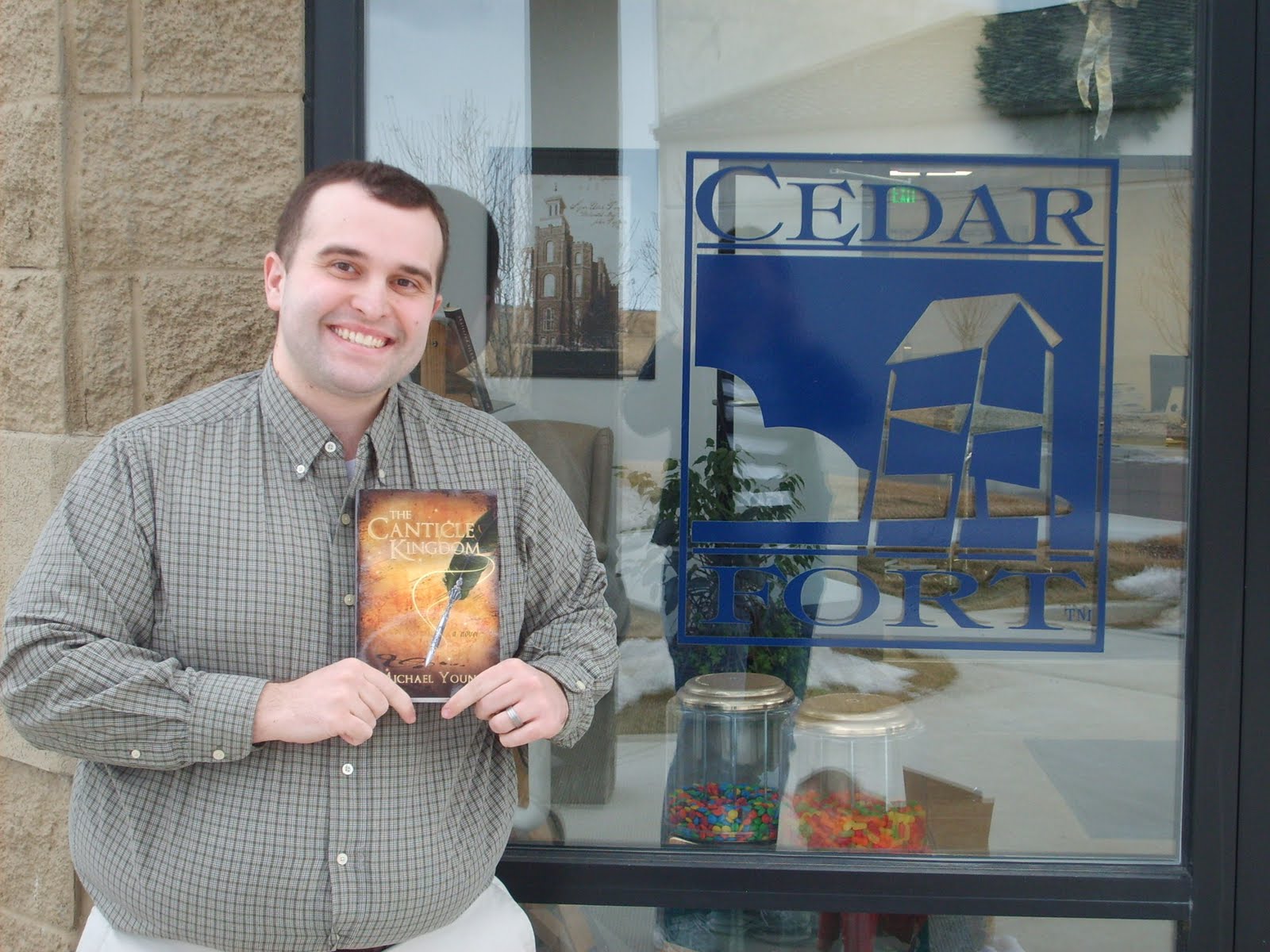
Here I am at the Layton Hills Mall in Layton, UT with the very first copy I’ve seen on the shelf. I’m pretty happy that they put it next to Harry Potter.

Here I am at the Layton Hills Mall in Layton, UT with the very first copy I’ve seen on the shelf. I’m pretty happy that they put it next to Harry Potter.
Due to some technical difficulties, I am extending the drawing of the countdown contest, and giving everyone a different way to enter. Simply send me and email at thecanticlekingdom@gmail.com with the subject of “Contest” and put your name and hometown in the message body.
Ex: Michael from Clearfield, UT.
I will make the drawing on the first of March. Good luck!


“The Canticle Kingdom” hits shelves today. From what I’ve heard, you can probably find it at Barnes and Noble, Deseret Book, Seagull Book, or online at amazon.com, barnesandnoble.com, or borders.com. Pick up a copy and let me know how you like it! Happy reading!

It is with a great deal of gratitude that I watch my book be sent out this week to the general public. I feel that I must thank many people, my wonderful wife, my incredible parents and siblings, the staff at Cedar Fort, and of course, our Heavenly Father, who is the source of all blessings. Now I just hope that you all will choose to read “The Canticle Kingdom” and that you will enjoy reading it as much as I enjoyed writing it.


I have also been asked what I had to do from the time it was accepted until it was released.
A lot of email and phone time.
I worked with the getting things ready for registering with the Library of Congress. I signed off on the cover. I gave suggestions of what could be edited out to make the book a little shorter. I read through the entire thing to make sure everything still made sense. I wrote a dedication for the front and a bio from the back. I had my picture taken for the “About the Author” section.
In addition, I started getting the word out about my book. As part of my contract, Cedar Fort gave me 10 free copies as well as a number of ARCs (Advance Reading Copies), which are a lower resolution copy of the book, with a black and white alternate cover. I sent these out to people who blog or write about fiction in hopes that they generate some positive reviews for the story.
It has been a wonderful time of waiting and anticipation.


It was one of the best emails that I had ever received. It was a day in late July and I was home by myself at our apartment in Orem. I have a special folder in my email inbox that catches anything sent to me by Cedar Fort. I had worked for a number of months on polishing the manuscript based on the suggestions I was given by the reviewer, and had submitted it again for their approval at the beginning of the summer.
They had just let me know that it had to go through one more reviewer and then they would get back to me on a final decision. I must have checked my email ten times a day. So, when I saw this one, I had a feeling this was it, good or bad—a process which had already taken several years.
I opened the email, saw the words “I have good news…we want to publish Inside the Box.” (Which was the working title at the time.), and nearly fell off my chair. I reached for my phone and called just about everyone I could think of, who knew I had been writing a book. Everyone from my wife to my parents, siblings and friends who have been so supportive during this process.
I was working a graveyard shift at the time and needed to go to bed before my shift, but I found it very difficult to sleep just then. Leave a comment this week for a chance to win a free signed copy.


I am sometimes asked what the revision process is like. “Painful, but useful.” It is hard to get away from the feeling that “Hey! Don’t touch that! I wrote it the way I wanted to the first time!” However, chances are, even your most brilliant prose is going to have some errors, or an ever better way you could say something at second glance.
There are different types of revisers, but I prefer the method of getting the whole first draft back on paper and then going back over the whole thing a bit at a time. I look for typos, awkward sentences (prune those adjectives and adverbs! They are a bit like salt: only good in measured amounts) and holes in the logic or plot. I have found that is sometimes good to keep a “character bible” to keep track of what traits you have assigned each person. If you give your protagonist blue eyes on page 2 and on page 12 he has brown eyes, your readers might raise an eyebrow.
By far, the most helpful thing I found, is to enlist the help of others. Let them read it over, and tell you where the weak spots are. Have the write down questions or things that did not make sense. The problem with reading your own manuscript, is that you know how everything is supposed to be, and it all makes sense in your head, so you are liable to glance over problems.
With “The Canticle Kingdom”, I was told that they needed to trim down the word count a bit to make it the right size for what the price they wanted to sell it at. I struggled with what to cut, and in the end took the leap of faith just to let Meg Welton, the editor, use her discretion. To my great relief, she did a wonderful job of trimming a few parts while leaving the core story intact. It can be done. It is hard to let your work fall under someone else’s sheers, but in the end it is worth it.
I would love to hear from the rest of you. How do you revise? What tips can you give that have worked for you? Leave a comment this week for a chance to win a free signed copy.


I just found out that I will be participating in a panel and doing a book signing at “Life, the Universe, and Everything”, a Sci-Fi/Fantasy conference at BYU. For more info visit: http://www.ltue.org/LTUE2010.html
The panel is at noon on Feb 12th, with the signing in the BYU Bookstore directly afterwards. Hope to see you there!


I’m also occasionally asked about the submission process. “How did you find someone to publish your book?”
I have to admit that I was pretty intimidated when the prospect first presented itself. I had heard from others and read what others had written about it, and it seemed like you needed to deliver your book with some fireworks or something just to get noticed.
I had also heard the stories about how rejection notices pile up on author’s desks. In submitting my short story work, I’ve found this to be very true. With the “The Canticle Kingdom”, however, I feel very blessed that it was accepted by the first publisher that I presented it to. This did not happen, however, because I used a special kind of scented neon paper (which, by the way, would probably get your submission thrown out), but that I was fortunate to meet a representative of Cedar Fort at BYU’s annual publisher’s fair. I really think that face to face contact helped me get remembered instead of getting lost in a mountain of email or mail submissions.
I’ll have to say as well, that the first answer was a “Yes, but…” They gave me a few things to polish up, which took considerable time. That sort of answer was good enough for me.
You cannot always attend a publisher’s conference, and even if you do, that is still no guarantee. In the meantime, just keep at it. Do you homework about the company and see what else they have published. Write a tight, interesting query letter, and let others critique it. I feel very blessed that I found a match relatively quickly for this book, and I know if you persevere, you can also find that match.
Let me hear from you and you’ll receive another shot at a free signed copy. Thank you for reading!


I’m also often asked, “How long did it take you to write?”
Well, that depends on which parts of the process you want to include in that. For the first draft, I would have to say “15 minutes at a time over the course of a year.” While I was writing the first draft, I was working full-time and going to school at Brigham Young University full-time, as well as being newly-married. Thus, I did not have time to sit down for hours at a time and pound away at my keyboard. Instead, I wrote in little snatches here and there, and did my thinking and formulating in the little in-between times, such as when I was walking to class or doing something menial like making dinner.
Each day did not seem like much, but over time those little bits really added up, like grains of sand piling up to create a huge mound of sand.
It felt nice to have that first draft, but it was far from the book that it ended up as. The revision took me about another year in all, and so I guess the most accurate answer to the question is “About two years.”
To anyone aspiring to write, I would say this: Writing does not have to take hours of your time every day. Even if you only have 10 – 15 min to devote, this small contributions given consistently can still add up to something you might be happy to call a finished manuscript.
How have you found ways to write even though you are busy? Let me hear from you and you’ll receive another shot at a free signed copy. Thank you for reading!

 Books by Michael D. Young