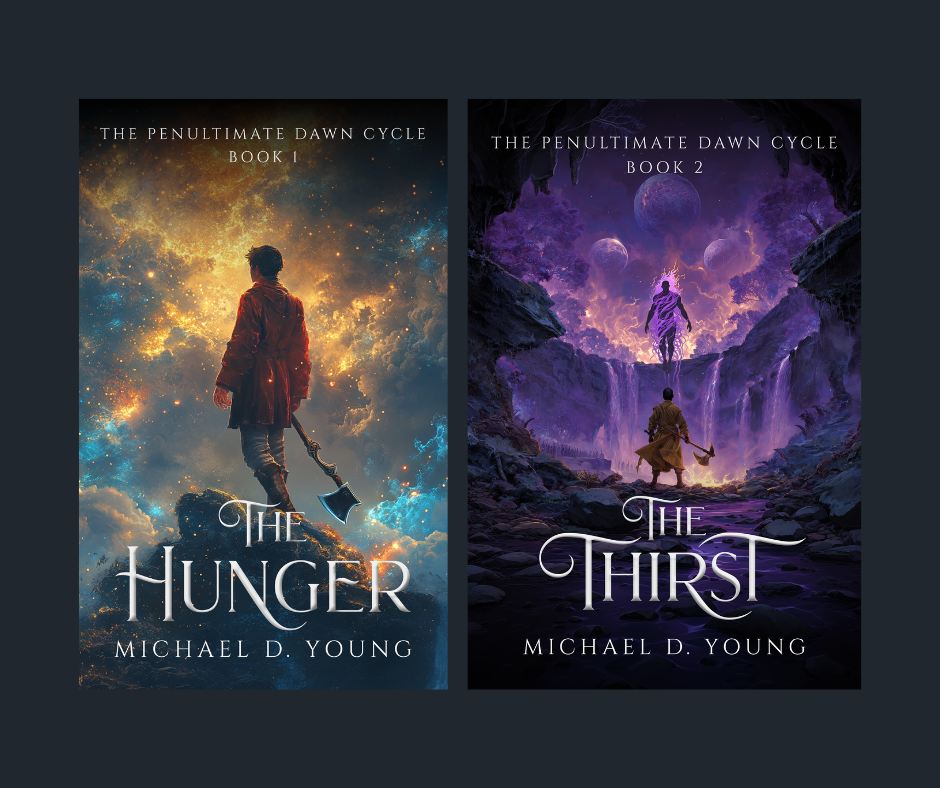
The Thirst begins after the catastrophic events of The Hunger, when Azil Harkness and his companions awaken to a world transformed by the Wrath. The familiar curse is changing, the monstrous Mals are experiencing a new and terrible need, and the powers once held together within Rahim have become competing forces with incompatible visions for the future.
Originally published April 1, 2021. Substantially revised and expanded July 2026.

Where the Story Begins
The first book establishes a world in which people depend on magical Sustenance. Those who cannot obtain enough are threatened by deformity, exile, madness, and death. Azil begins as a scholar drawn into forces much larger than his private studies, while Kaval, Evelet, Jamith, Sarhah, and others reveal different ways people survive inside the same broken system.
By the beginning of The Thirst, survival is no longer defined by the rules the characters understood. The aftermath of the Wrath has changed both the physical world and the magical balance beneath it.
A sequel works best when the first book’s victory creates new consequences rather than resetting the board. The characters may have survived one crisis, but their choices have altered what comes next.
The Mals and a New Kind of Hunger
The Mals were already driven by a desperate dependence on Sustenance. In the second book, they begin speaking of something different: the Thirst. This new sensation drives them deeper into madness while also raising questions about what the curse is becoming.
Changing the vocabulary of a threat changes the reader’s expectations. Hunger suggests emptiness and survival. Thirst suggests urgency, fever, and a need that may intensify more quickly. The distinction allows the sequel to remain connected to the first book while developing its own identity.
The Mals are not only obstacles. Their condition exposes the moral failure of a society that benefits from magical power while allowing vulnerable people to become disposable. As the curse changes, the characters must decide whether the Mals are enemies to defeat, victims to heal, or something more complicated than either category.
The Aspects at War
The different Aspects of Rahim are no longer moving toward a single purpose. Some seek to reunite the full power of the Aspects, believing restoration will save the Realm. Others fight to keep that power divided, convinced that reunification would repeat or magnify an ancient disaster.
This conflict turns magical theology into political action. Each faction interprets the same history differently. Each believes it understands the danger. Each can point to real evidence, which makes compromise more difficult and manipulation easier.
- Is divided power safer because no single person can control everything?
- Is reunification necessary because fragments cannot repair a broken world?
- Can power be restored without restoring the failures that shattered it?
- Who has the right to make a decision that affects every person in the Realm?
Azil after the Wrath
Azil enters the sequel with greater power and greater responsibility. Knowledge that once seemed safely academic now has immediate consequences. Allies look to him for answers, enemies understand his importance, and prophecy threatens to turn his identity into a role he did not choose.
The central challenge is not merely whether Azil can become stronger. It is whether he can remain recognizably himself while using forces capable of changing the world. Power can solve immediate problems while creating distance from the people the hero intended to protect.
A Journey Below the Earth and into the Heavens
The keys to ending the conflict lie in places that expand the scale of the series in opposite directions. One path leads into a long-forgotten city deep beneath the earth. Another reaches toward the moons hanging over the Realm.
Those settings reflect the story’s thematic movement. The underground city asks characters to confront what history buried. The journey toward the heavens asks what exists beyond the world they assumed was complete.
New locations should do more than provide impressive scenery. Each one needs its own rules, history, dangers, and revelations. The environment should change what the characters can attempt and what they learn about the larger conflict.
Escalating a Sequel Without Repeating Book One
- Change the problem. The Thirst is related to the Hunger but not identical to it.
- Complicate the factions. The Aspects have goals that cannot be reduced to one obvious good side and one obvious evil side.
- Carry consequences forward. The Wrath reshapes the world rather than disappearing between volumes.
- Expand the geography. Forgotten depths and distant moons enlarge what the characters believe is possible.
- Deepen the personal stakes. Azil’s growing power affects relationships, identity, and trust.
Themes at the Center of The Thirst
Need and Dependence
The series asks what happens when survival depends on a resource controlled by institutions, traditions, and people with unequal power. The changing curse makes that dependence even less predictable.
Unity and Control
Reuniting divided power may promise healing, but unity created through domination is not the same as reconciliation. The book places those ideas in conflict.
Knowledge and Responsibility
Azil’s scholarship gives him access to truths others have forgotten or concealed. Knowledge becomes morally significant when acting on it can save or destroy entire communities.
Hope after Catastrophe
The characters are not trying to restore the exact world that existed before the Wrath. That world contained the conditions that produced the catastrophe. Their task is to imagine a new dawn without repeating the old darkness.
Read or Listen to The Thirst
The Thirst is the second book of The Penultimate Dawn Cycle. Readers should begin with The Hunger to experience the world, characters, and consequences in order.

About Michael D. Young
Michael D. Young writes family-friendly fantasy, devotionals, hymn history, and books for young readers. He has sung with The Tabernacle Choir at Temple Square since 2010 and works as an instructional designer. Explore his books, music, and creative projects.