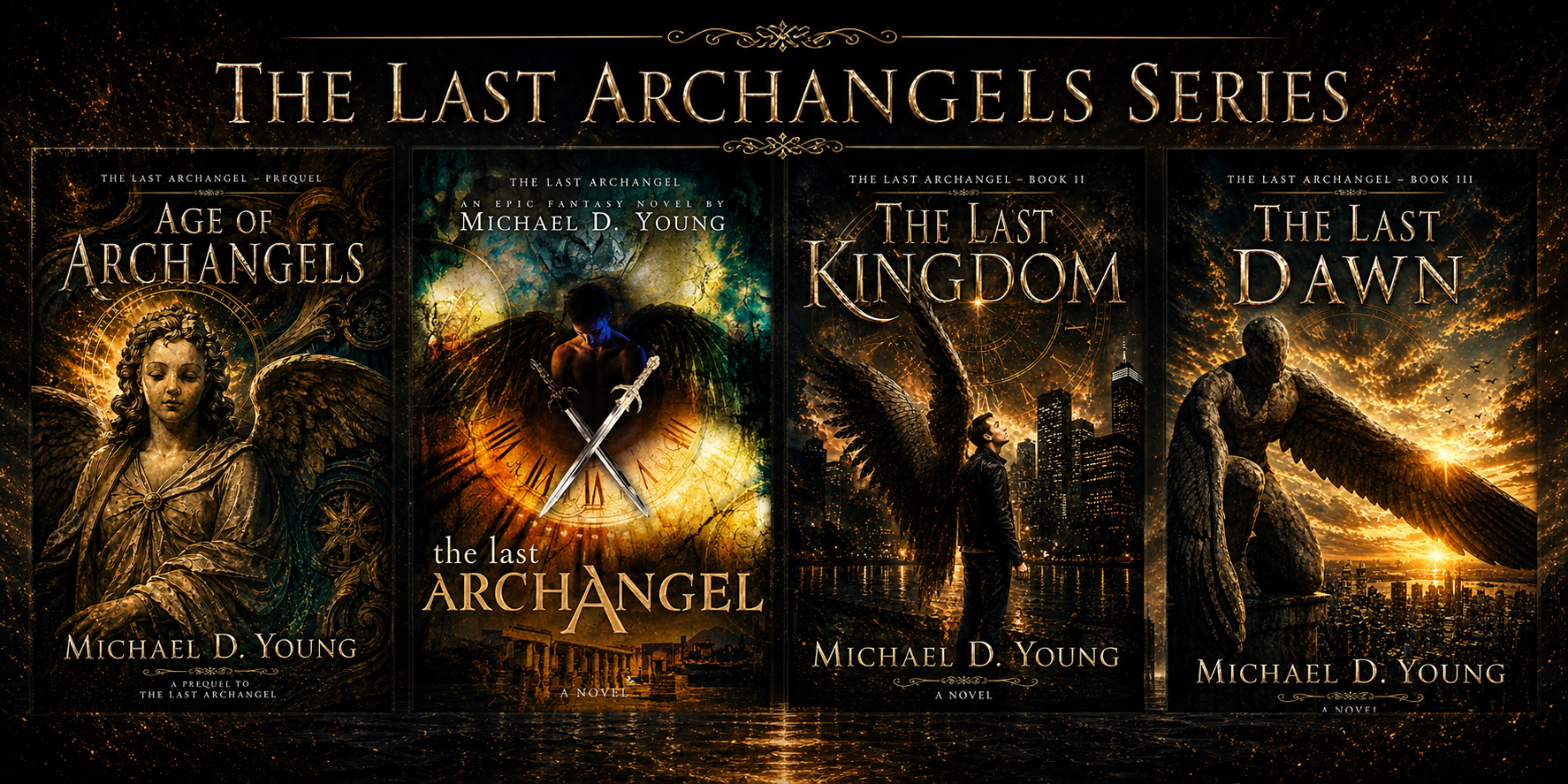
The Last Archangel began with a fallen angel who had all the power in the world and almost none of the freedom. When Cedar Fort accepted the novel for publication, that central contradiction carried the project from private manuscript to cover design, soundtrack experiments, interviews, a blog tour, and a launch celebration built around angels, demons, and one very reluctant destroying angel.
Originally published January 18, 2011. Substantially revised and expanded July 2026.

The Publishing Announcement
In January 2011, I learned that Cedar Fort wanted to publish the project then tentatively titled The Last Archangel. The announcement was exciting, but it also began the practical work of turning the manuscript into a book readers could recognize, understand, and find.
The novel centers on Xandir, a fallen Watcher condemned to serve as the Destroying Angel until the end of time. He has spent thousands of years delivering judgments he does not always understand. When fallen powers offer to restore the mortal woman he loves, the price is almost impossible to imagine: Xandir must help them bring about the end of the world.
To save one mortal life, an immortal must decide whether redemption is worth the destruction of everyone else.
Building a Fallen Angel Who Could Still Change
Xandir needed to be powerful enough to carry the title “Destroying Angel” and flawed enough to require a genuine character arc. His punishment gives him enormous authority, but it also prevents him from escaping the consequences of his earlier choices.
I wanted the story to explore judgment, compassion, obedience, forbidden knowledge, and the dangerous ways love can become possessive. Xandir does not begin as a conventionally gentle angel. He is quick-witted, impatient, proud, and accustomed to destruction. The moral pressure of the story comes from forcing him to look beyond labels and recognize the individual lives hidden inside large decisions.
The Meaning Behind the Cover

The original cover design incorporated several details from the novel:
- The crossed swords: Xandir carries a light sword and a dark sword. Crossing them forms an X that echoes his name and the opposing forces within him.
- The ruins: The broken landscape reflects his vocation. A destroying angel leaves evidence behind.
- The shadowed figure: Xandir is celestial, but fallen. The darkness suggests both punishment and moral uncertainty.
- The time motifs: His sentence lasts until the end of time, making clocks and temporal imagery central to the book’s identity.
- The downward gaze: He stands above humanity while also being forced to confront what his judgments do to individual people.
Music, Angels, and the Writing Atmosphere
Music frequently becomes part of my writing process. While working on The Last Archangel, I listened to songs connected with angels, loss, judgment, longing, and the boundary between heaven and earth. The playlist was never an official soundtrack, but it helped establish emotional temperature while I drafted later installments and related material.
The exercise also reminded me that familiar religious imagery has accumulated many cultural layers. Angels appear in hymns, popular songs, greeting cards, cemetery art, films, and folklore. The novel plays with some of those expectations while creating its own hierarchy of Watchers, cherubim, seraphim, fallen powers, and Giants.
Launching the Book
The launch weekend included a signing at Barnes & Noble and a family-friendly park celebration. The event mixed ordinary book-launch needs—books, bookmarks, signage, readings, and conversation—with details drawn from the novel.


The first customer who purchased a copy told me her book club planned to read it. That was a gratifying reminder that a launch is not only an author’s milestone. It is the point where readers begin creating their own relationship with the book.
Imagining the Cast
Like many authors, I once played the game of choosing actors for the characters. My early pick for Xandir emphasized physical intensity, action experience, and the ability to combine menace with humor.
Over time, however, I became less interested in attaching the character to a specific celebrity and more interested in preserving his own visual identity: long pale hair, gray eyes, a powerful build, translucent wings, two opposing swords, and the exhaustion of someone who has been carrying out judgments for millennia.

Lessons from the Launch
- A clear concept helps readers remember a book. “A fallen destroying angel tempted to end the world” is easier to carry away than a long explanation of every subplot.
- Visual details should reinforce the story. Swords, clocks, wings, ruins, and opposing light and darkness all support the same central conflict.
- An event works best when readers can participate. Trivia, food, children’s activities, and conversation made the launch more than a sales table.
- Old promotional experiments can become lasting background material. Playlists, interviews, and launch photographs now help document the book’s creative history.
- The current series page should remain the source of truth. Covers, formats, purchase links, and character information change long after a launch announcement is published.
Enter the World of The Last Archangel
Meet the characters through the refreshed interviews with Xandir, Eden Fortuna, and Jarom.

About Michael D. Young
Michael D. Young writes family-friendly fantasy, devotionals, hymn history, and books for young readers. He has sung with The Tabernacle Choir at Temple Square since 2010 and works as an instructional designer. Explore his books, music, and creative projects.
7 responses to “Behind The Last Archangel: From Contract to Launch”
Congratulations! It sounds like a great book.
Congratulations, Mike. I remember thinking that this sounded really cool when I read your query letter. I'm happy for you and look forward to reading the book!
[…] Explore The Last Archangel Series Read the Behind-the-Book Story […]
[…] Explore The Last Archangel Series Read the Behind-the-Book Story […]
[…] Explore The Last Archangel Series Read the Behind-the-Book Story […]
[…] the full creative and launch history in Behind The Last Archangel: From Contract to Launch. Explore the current book and character resources on The Last Archangel Series. For cover design, […]
[…] Behind The Last Archangel: From Contract to Launch […]